Posted on: 11/Mar/2026 | By Dr. Ritesh Gaikwad
Carotid Artery Blockage Symptoms & Treatment in Thane Vascular Surgeon Dr. Ritesh Gaikwad
By Dr. Ritesh Gaikwad – Vascular & Endovascular Surgeon, Thane & Mumbai
Introduction
Stroke is one of the leading causes of disability in India. And nearly 1 in 5 strokes are caused by blockages in the carotid artery — the main blood supply to your brain. The alarming truth? Most people don't know they have a blockage until a stroke occurs.
I'm Dr. Ritesh Gaikwad, vascular surgeon in Thane and Mumbai. In this article, I'll walk you through everything you need to know about carotid artery blockage: the silent symptoms, how we detect it, and the latest treatments — from carotid surgery to carotid stenting — that can prevent a stroke before it happens.
What is Carotid Artery Blockage?
Think of your carotid arteries as two important highways on each side of your neck. Their only job? To carry oxygen-rich blood from your heart to your brain.
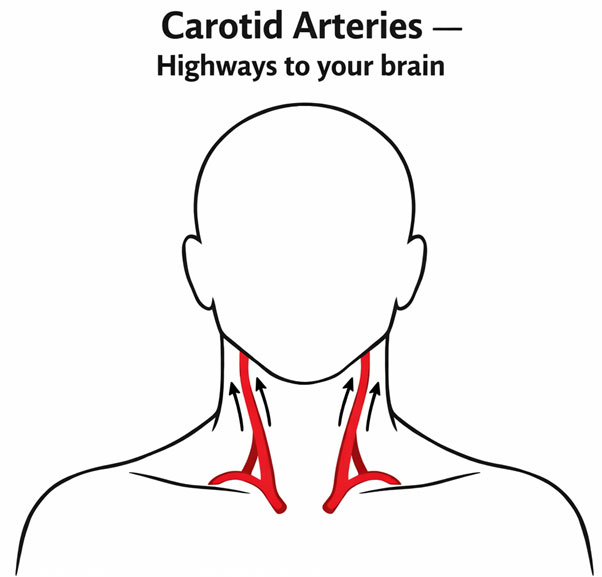
When these highways become narrow or blocked, it's called carotid artery blockage or carotid artery disease.
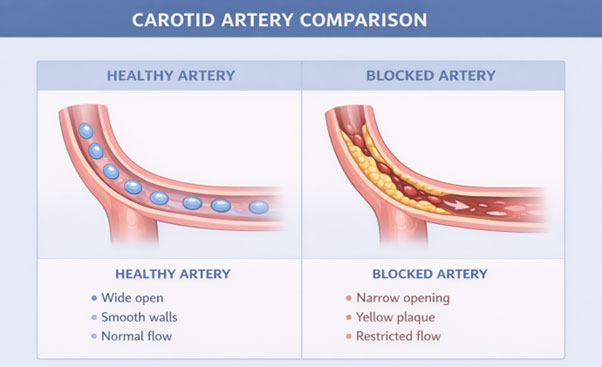
The blockage happens due to a substance called plaque. Just like normal aging, our arteries naturally undergo wear and tear over time. But this process is aggravated by certain health conditions like:
- Diabetes – High blood sugar damages artery walls
- High blood pressure – Extra pressure hurts arteries
- High cholesterol – More building material for plaque
Symptoms of Carotid Artery Blockage
Plaque builds up slowly over many years. It's made of cholesterol, fat, calcium, and other substances in your blood.
As plaque grows, the artery opening becomes smaller. Less blood reaches your brain. And in some cases, a piece of plaque can break off and travel directly to the brain.
The medical term: This condition is called extracranial carotid artery disease. "Extracranial" simply means "outside the skull" — because the blockage happens in the neck, not inside the brain.
Why this matters: The danger is that this process happens silently. Most people feel perfectly fine while the blockage worsens over years. That's why the first sign is often a devastating stroke.
Why Should You Care? The Stroke Connection
A blocked carotid artery can directly cause a stroke and stroke changes lives forever not just for the patient, but for the entire family.
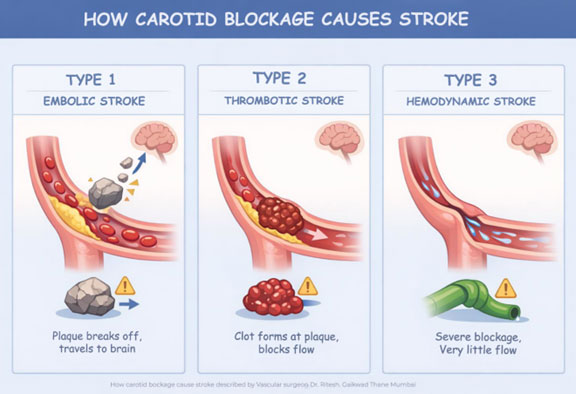
Three Ways Blockage Causes Stroke
| Type of Stroke | Explanation |
|---|---|
| Embolic Stroke | A piece of plaque breaks off and travels to the brain. |
| Thrombotic Stroke | A blood clot forms at the blockage and blocks blood flow. |
| Hemodynamic Stroke | Severe blockage (>70%) reduces blood flow to the brain. |
What Stroke Takes Away

| Loss | What It Looks Like |
|---|---|
| Mobility | Not being able to walk to the bathroom alone |
| Speech | Struggling to say "I love you" to your children |
| Independence | Needing help to eat, dress, or bathe |
| Dignity | Losing the ability to care for yourself |
| Role in family | Going from caregiver to dependent |
The Good News: Stroke from carotid artery blockage is PREVENTABLE. When we detect and treat the blockage early — before a stroke happens — we protect your brain and your quality of life.
Data That Matters: Studies from India show that among people with risk factors like diabetes and high blood pressure, 44% have some form of carotid artery disease. And 6 out of every 100 have significant blockage needing immediate attention.
Who is at Risk for Carotid Artery Blockage?
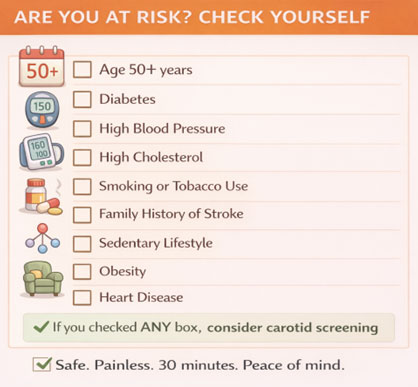
Risk Factors: Check If Any Apply to You
| Risk Factor | Why It Increases Risk |
|---|---|
| Age (50+ years) | Arteries naturally wear with age |
| Diabetes | High sugar damages artery lining |
| High Blood Pressure | Pressure injures artery walls |
| High Cholesterol | More building material for plaque |
| Smoking or Tobacco Use | Damages arteries and makes blood sticky |
| Obesity | Increases strain on heart and arteries |
| Sedentary Lifestyle | Slows blood circulation |
| Family History | Higher risk if parent or sibling had stroke |
| Heart Disease | Often linked with carotid artery disease |
The Indian Context
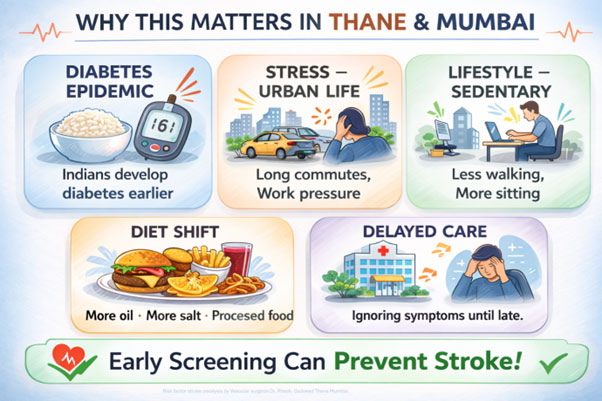
In India, we face unique challenges:
- Diabetes epidemic — Indians develop diabetes at younger ages
- Stressful urban life — Long commutes and work pressure in cities like Mumbai and Thane
- Dietary shifts — Increased consumption of oil, salt, and processed foods
- Delayed healthcare — Many people ignore symptoms until the condition becomes serious
What This Means for Your Health
Knowing your risk factors means you can take control. A painless, 30-minute ultrasound at our clinic in Thane can help determine:
- Whether you have any blockage
- How much blockage exists
- Whether you need treatment or just monitoring
As a vascular surgeon in Thane, I've seen too many patients walk in after a stroke saying, "Doctor, I had no idea. Nobody told me to get checked." Please don't let that be your story.
Warning Signs — Don't Ignore These
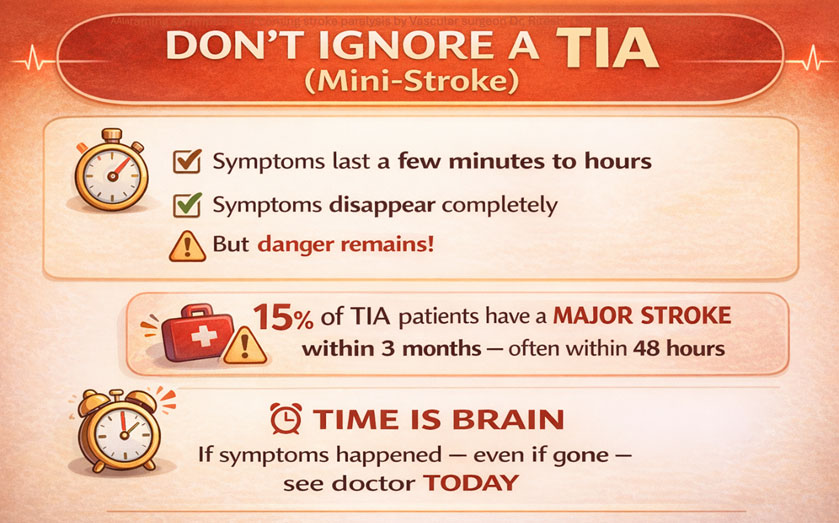
What is a TIA (Mini-Stroke)?
| Term | Meaning |
|---|---|
| TIA | Transient Ischemic Attack |
| Plain English | A temporary blockage of blood flow to part of your brain |
| Duration | Symptoms last minutes to hours |
| After effects | Complete recovery — symptoms disappear |
The Danger: 15% of TIA patients will have a major stroke within 3 months, often within 48 hours.
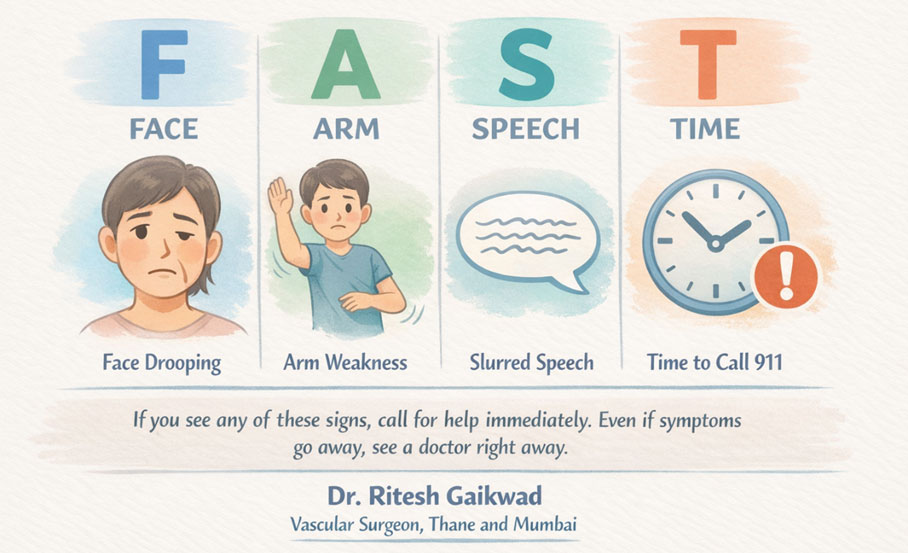
FAST Infographic
Other Warning Signs
| Warning Sign | What It Feels Like |
|---|---|
| Sudden numbness | One side of the face, arm, or leg feels numb or goes “asleep” |
| Sudden confusion | Trouble understanding speech or difficulty speaking clearly |
| Sudden vision trouble | Vision in one eye becomes blurry, dim, or suddenly dark |
| Sudden dizziness | Difficulty walking, loss of balance or coordination |
| Sudden severe headache | A sudden intense headache often described as the worst headache of your life |
A Critical Warning: Even if symptoms last only 5 minutes and then disappear — take them seriously. It was NOT nothing. It was a warning.
How is Carotid Artery Blockage Diagnosed?
Carotid Duplex Ultrasound — The Gold Standard
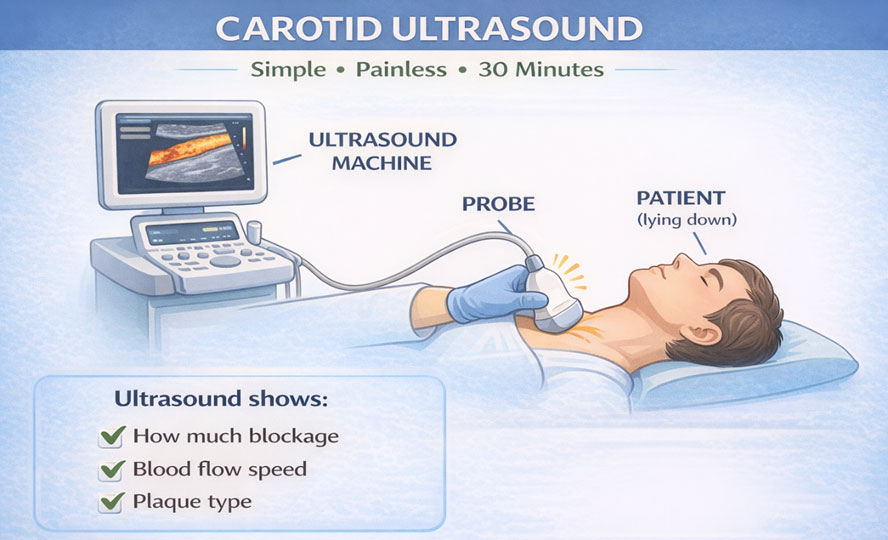
The good news? Diagnosing carotid artery disease is simple, painless, and quick.
| Question | Answer |
|---|---|
| What is it? | A painless scan using sound waves |
| How does it feel? | Warm gel on neck, gentle probe — like pregnancy ultrasound |
| How long? | 30–45 minutes |
| Any pain? | None at all |
| What does it show? | Blockage percentage, blood flow speed, plaque type |
What the Numbers Mean
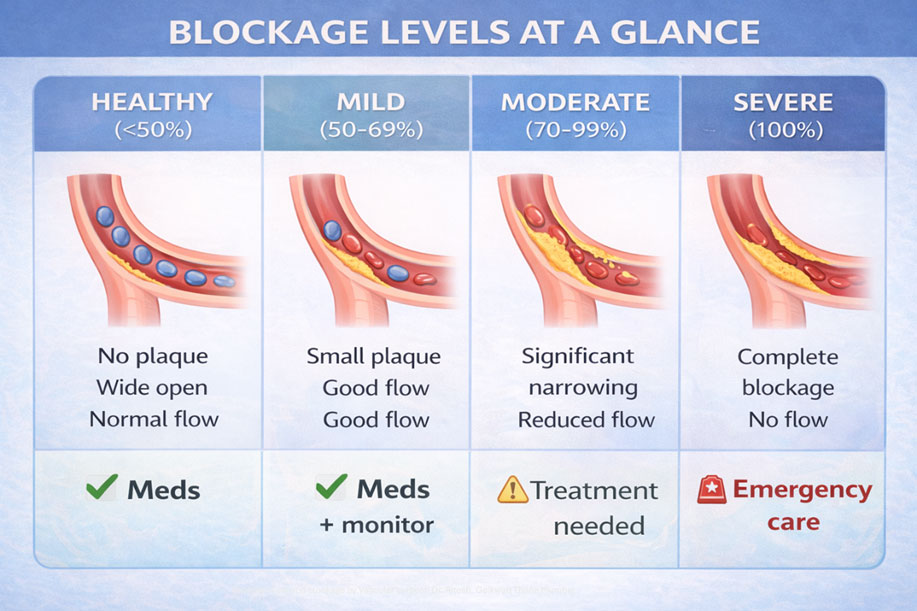
| Blockage | Category | What It Means |
|---|---|---|
| < 50% | Mild | Medicines and lifestyle changes with regular monitoring |
| 50–69% | Moderate | Consider treatment if symptoms are present |
| 70–99% | Severe | Strongly consider carotid surgery or carotid stenting |
| 100% | Complete | Emergency — needs immediate medical care |
Additional Tests (If Needed)
| Test | Why Used |
|---|---|
| CT Angiography | Provides detailed 3D images and helps in planning treatment |
| MR Angiography | Shows excellent soft tissue detail without radiation |
| Conventional Angiography | Considered the gold standard and usually performed during intervention |
Where to Get Tested: Doctor Planet and KIMS Hospital have modern ultrasound facilities for painless carotid artery screening.
Treatment Options — How We Protect Your Brain
If you have carotid artery blockage, you are not helpless. Modern medicine offers excellent treatments.
Treatment Option 1: Medical Management
For mild blockage (<50%) or some moderate cases.
| Treatment | Purpose |
|---|---|
| Blood thinners | Prevent blood clots |
| Statins | Lower cholesterol and stabilize plaque |
| BP tablets | Control blood pressure |
| Diabetes control | Manage blood sugar levels |
| Smoking cessation | Single most important step to reduce risk |
| Exercise | At least 30 minutes of physical activity daily |
| Healthy diet | Reduce oil and salt intake, increase vegetables and fruits |
Treatment Option 2: Carotid Endarterectomy (Surgery)
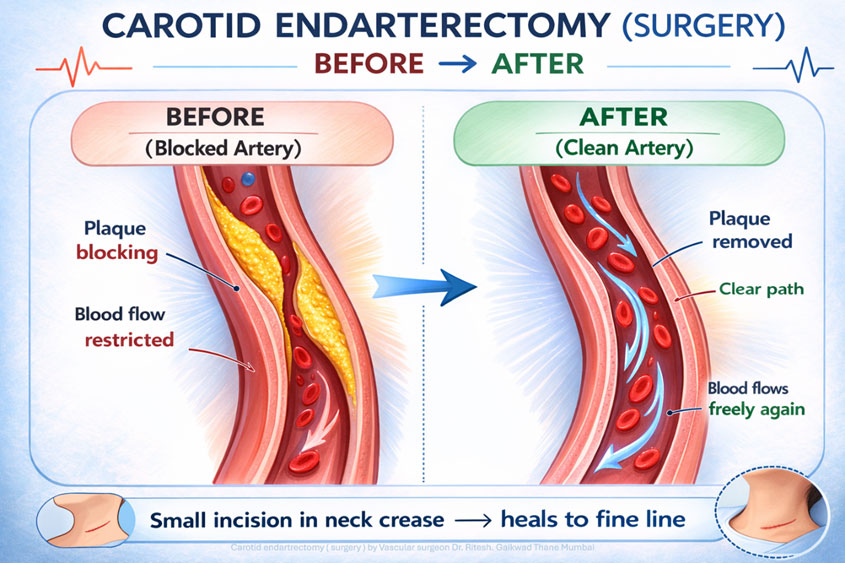
What It Is: A surgical procedure to remove the plaque from your carotid artery. It is similar to cleaning out a clogged pipe to restore proper blood flow.
The Procedure:
- Small incision in the natural crease of the neck
- The artery is carefully opened
- The plaque causing the blockage is removed
- The artery is closed and normal blood flow is restored
Advantages:
- Complete plaque removal
- 50+ years of proven success
- Low recurrence rate
Recovery:
- Hospital stay: 1–3 days
- Back to normal activities: 2–4 weeks
Treatment Option 3: Carotid Artery Stenting
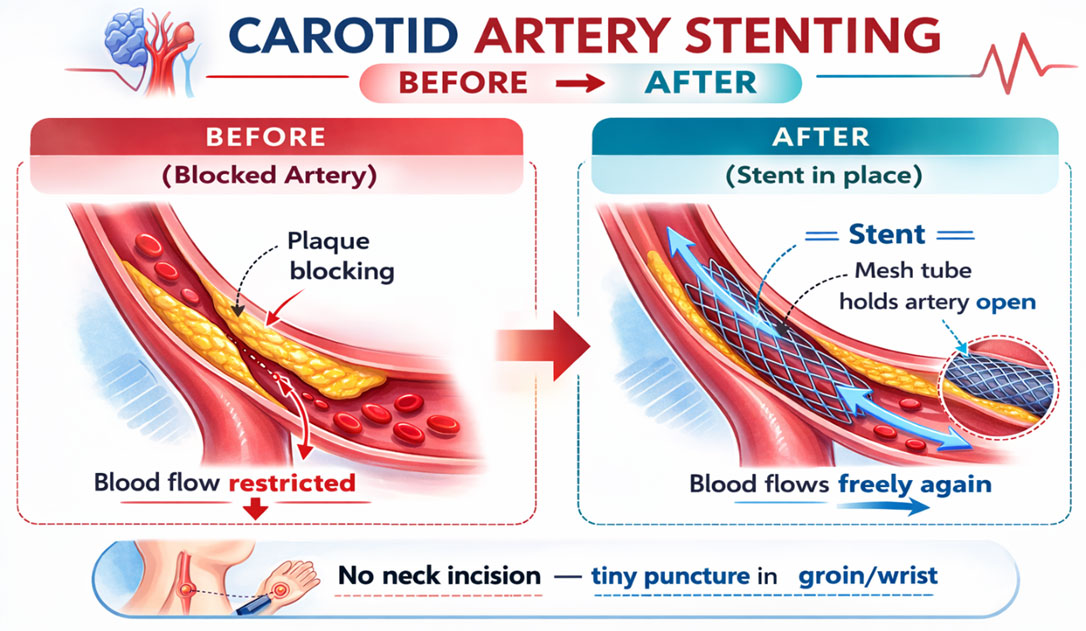
What It Is: A minimally invasive procedure where a small mesh tube (stent) is inserted to open the blockage from inside the artery. No neck incision is required.
The Procedure:
- Tiny puncture in groin or wrist
- A catheter is guided to the blockage
- A stent is placed to keep the artery open
- Blood flow is restored
Advantages:
- No neck incision
- Shorter hospital stay (1–2 days)
- Faster recovery (1–2 weeks)
- Ideal for high-risk patients
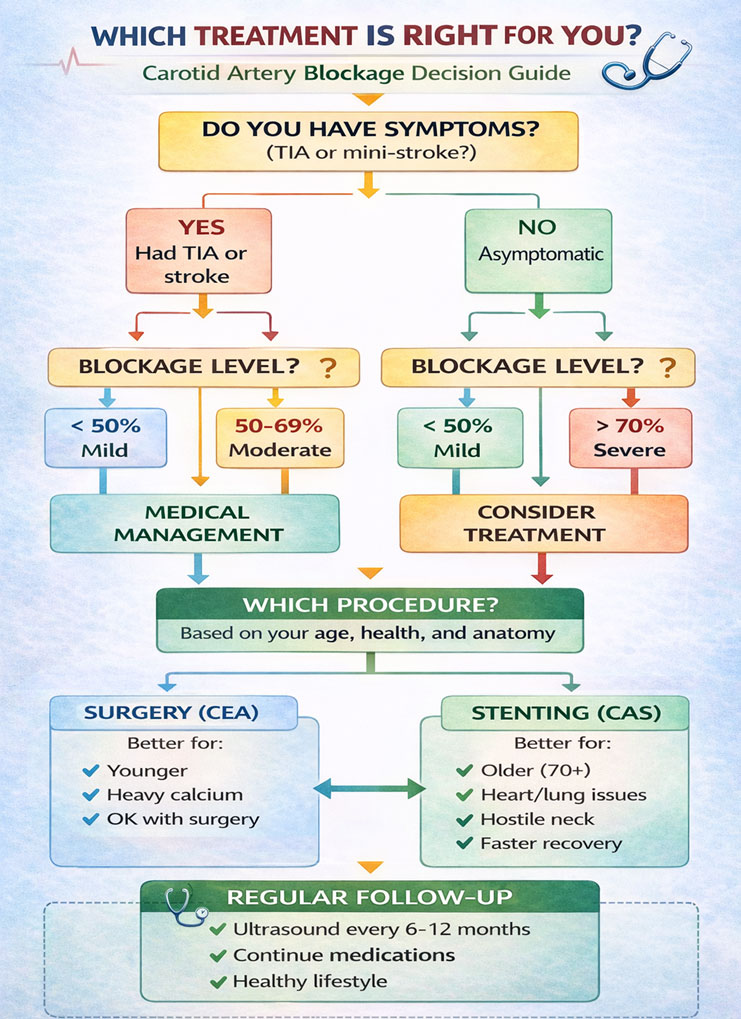
Which is Right for You?
| Factor | Favors Surgery | Favors Stenting |
|---|---|---|
| Age | Younger | Older (70+) |
| Heart condition | Caution | May be safer |
| Neck anatomy | Favorable | Hostile neck |
| Plaque type | Heavy calcium | Softer plaque |
| Recovery preference | OK with 2–4 weeks | Wants faster recovery |
As a vascular surgeon skilled in both carotid surgery and carotid stenting, I recommend what is truly best for you — not just what I know how to do.
Recovery and Follow-Up
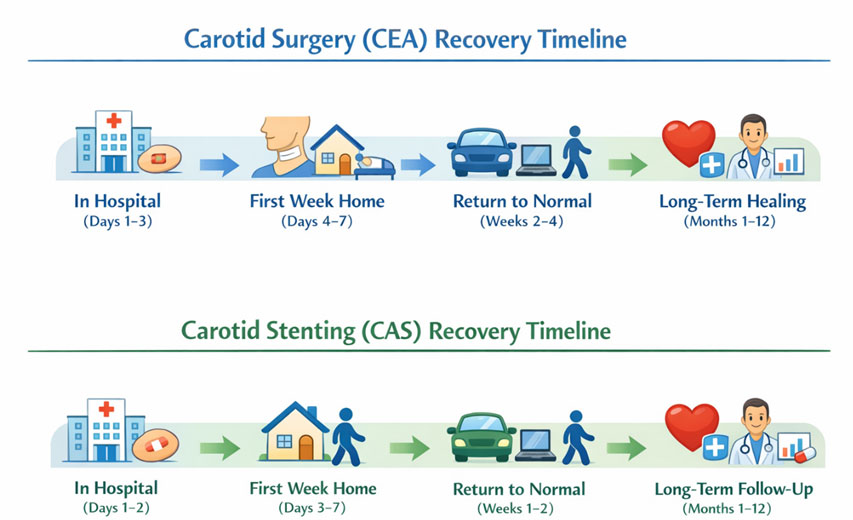
Recovery After Carotid Surgery
| Stage | Timeline | Key Points |
|---|---|---|
| In Hospital | Days 1–3 | Neck soreness, walking with help |
| First Week Home | Days 4–7 | Rest, gentle walk, no driving |
| Return to Normal | Weeks 2–4 | Driving and desk work usually possible in 2–3 weeks |
| Full Recovery | Weeks 4–6 | All activities return to normal |
Recovery After Carotid Stenting
| Stage | Timeline | Key Points |
|---|---|---|
| In Hospital | Days 1–2 | Rest flat if groin approach |
| First Week Home | Days 3–7 | Gentle walks and puncture site care |
| Return to Normal | Weeks 1–2 | Driving in 2–3 days, desk work in 3–5 days |
| Full Recovery | Weeks 2–4 | All activities return to normal |
Long-Term Follow-Up
| Time | What Happens |
|---|---|
| 2–4 weeks | First follow-up visit |
| 6 months | Carotid ultrasound |
| 12 months | Another ultrasound |
| Yearly | Annual check-up |
Lifestyle Changes That Protect You
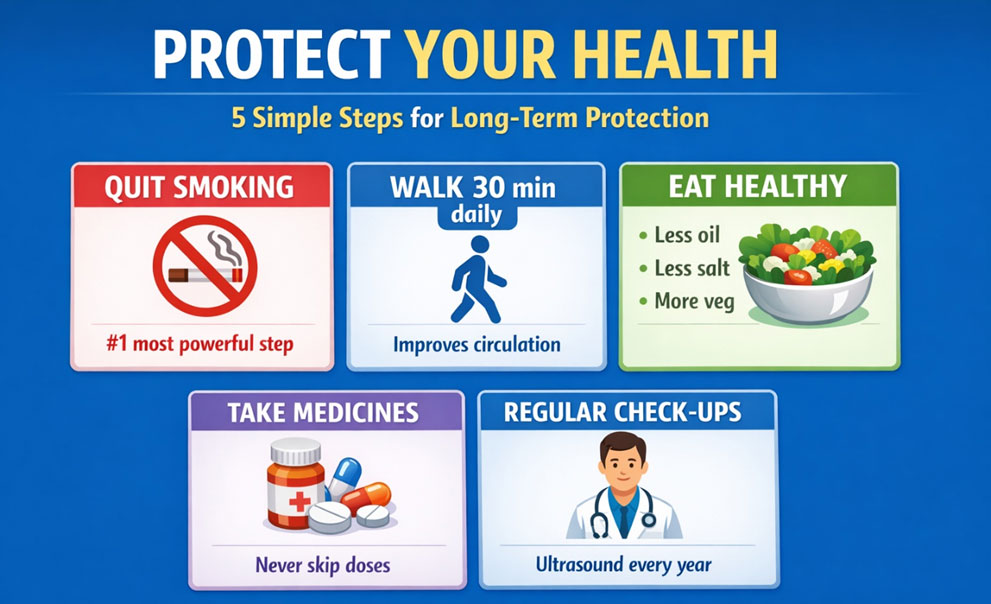
| Lifestyle Change | Why It Helps |
|---|---|
| Quit smoking | Single most powerful step |
| Walk 30 minutes daily | Improves circulation |
| Eat heart-healthy | Less oil, salt; more vegetables |
| Take medicines regularly | Never skip doses |
| Regular check-ups | Catch problems early |
Why Choose Dr. Ritesh Gaikwad in Thane?
Dr. Ritesh Gaikwad
MBBS, DNB (Gen Surg), DNB (Vascular Surg)
Vascular Surgeon | Thane & Mumbai
15+ Years Experience
Promise to You
| Promise | What It Means |
|---|---|
| I will listen | No rushing, I understand your concerns |
| I will explain | Simple language, no medical jargon |
| I will guide | Help you choose the right treatment |
| I will be there | From diagnosis through recovery |
| I will respect you | Your dignity and choices matter |
Why Patients Choose Us
1. Expertise You Can Trust
- MBBS, DNB General Surgery, DNB Vascular Surgery
- 15+ years experience
- Skilled in both carotid surgery and carotid stenting
2. Convenient Thane Locations
| Clinic | Address | Timings |
|---|---|---|
| Doctor Planet | Empire CHS Building, Shahid Mangal Pandey Road, Thane West | Tue, Thu, Sat: 5:30–7:30 PM |
| KIMS Hospital | Queens Street, Hiranandani Estate, Patlipada, Ghodbunder Road, Thane West | Mon–Fri: 10:00 AM–3:00 PM |
3. Patient-Centered Approach
- Explain options, then help you decide the best treatment
- Take time to answer all your questions
- Speak in simple and clear language
- Support you throughout the recovery process
Contact Information
Phone: 9619332942
Email: vascularhealthcentre@gmail.com
Website: www.riteshgaikwad.com
Doctor Planet
📍 Empire CHS Building, Shahid Mangal Pandey Road, Thane West
🕒 Tue, Thu, Sat | 5:30 – 7:30 PM
KIMS Hospital
📍 Queens Street, Hiranandani Estate, Patlipada, Ghodbunder Road, Thane West
🕒 Mon – Fri | 10:00 AM – 3:00 PM
Frequently Asked Questions
Q1: I feel fine. Do I really need to get checked?
Answer: Most people with carotid artery blockage feel perfectly fine. That’s what makes it dangerous. A 30-minute painless ultrasound can provide peace of mind or help detect blockage early.
Q2: Which is better — surgery or stenting?
Answer: There is no single “best” option. It depends on your age, overall health, and artery anatomy. As a vascular surgeon, I offer both carotid surgery and carotid stenting, so the treatment recommendation is based on what is best for you.
Q3: How long is recovery?
Answer: Recovery after carotid surgery usually takes around 2–4 weeks, while recovery after carotid stenting is typically 1–2 weeks depending on the patient’s condition.
Q4: Will I have a big scar after surgery?
Answer: The incision used in carotid surgery is small and placed within a natural crease of the neck. Over time it heals into a fine line and becomes barely noticeable.
Q5: Will I feel the stent inside my artery?
Answer: No. Patients cannot feel the stent at all. It stays inside the artery and helps maintain normal blood flow to the brain.
Q6: Do you have clinics in Thane?
Answer: Yes. Dr. Ritesh Gaikwad consults at Doctor Planet (Tue, Thu, Sat evenings) and KIMS Hospital (Mon–Fri mornings) in Thane West.
Q7: How do I book an appointment?
Answer: You can call 9619332942, email vascularhealthcentre@gmail.com, or visit www.riteshgaikwad.com to book an appointment.
CONCLUSION: The Choice is Yours
Your carotid arteries are the lifelines to your brain. Every day, they quietly do their job — delivering oxygen and nutrients that keep you thinking, speaking, moving, and living independently.
But when plaque builds up, these lifelines narrow. And one day, without warning, they can close completely — or send a clot to your brain.
That moment changes everything.
The Hard Truth
- Stroke doesn't ask your permission. It doesn't warn you in advance. It simply takes.
- It takes your ability to walk to the bathroom alone.
- It takes your power to say "I love you" clearly.
- It takes your independence, your dignity, and your place in your family.
- And once taken, these things are rarely fully returned.
The Empowering Truth
- You don't have to wait for that to happen.
- A simple, painless 30-minute ultrasound at our clinic in Thane can tell you:
- Are your arteries healthy?
- Is there early plaque we can manage?
- Is there dangerous blockage we need to treat?
- If nothing is found — you walk away with peace of mind.
- If something is detected — you can take action and protect your future.
Promise to You
I've spent over 15 years as a vascular surgeon, helping patients just like you. I've seen the fear in their eyes, answered their endless questions, held their hands before surgery, and celebrated with them after recovery.
I offer both carotid surgery and carotid stenting — so my recommendation is based on what’s best for you, not just the procedures I perform.
But more than that, I offer something simpler:
- I will listen to your concerns
- I will explain in plain language
- I will guide you through every step
- I will be there long after treatment is done
The Bottom Line
- A stroke can happen in minutes. Prevention takes just one appointment.
- You've taken the time to read this article. That means you care about your health. Now take the next step.
- If you're over 50, have diabetes or high blood pressure, smoke, or have a family history of stroke — don't wait for a warning that may never come.
- Pick up your phone. Call the clinic and book that ultrasound.
- Because the best treatment for carotid artery disease is the one that happens before a stroke, not after.
- Your brain is irreplaceable. Your independence is priceless. Protect them both.
Dr. Ritesh Gaikwad
MBBS, DNB (Gen Surg), DNB (Vascular Surg)
Vascular Surgeon | Thane & Mumbai
15+ Years Experience
📞 9619332942
✉️ vascularhealthcentre@gmail.com
🌐 www.drriteshgaikwad.com
Doctor Planet Clinic
📍 Empire CHS Building, Shahid Mangal Pandey Road, Thane West
🗓️ Tuesday, Thursday, Saturday | ⏰ 5:30 – 7:30 PM
KIMS Hospital
📍 Queens Street, Hiranandani Estate, Patlipada, Ghodbunder Road, Thane West
🗓️ Monday – Friday | ⏰ 10:00 AM – 3:00 PM
A 30-minute ultrasound could save your brain. Don't wait.